
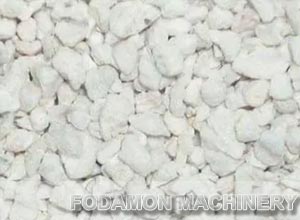
Perlite Crushing and Grinding Processing Solution
Perlite is a natural volcanic glass with high water content and excellent expansion properties. After crushing, grinding, and thermal expansion, perlite can be processed into lightweight insulation material, construction filler, horticultural substrate, filtration aid, and industrial powder products.
Different perlite applications require different particle sizes. Coarse perlite can be used for expansion and lightweight aggregate production, while finer perlite powder may be used in construction materials, fillers, coatings, and industrial processing. Fodamon can provide suitable perlite crushing and grinding equipment according to raw material size, required fineness, capacity, and final application.
Perlite Material Characteristics
- Natural Volcanic Glass – Perlite is formed from volcanic activity and contains internal water that allows it to expand when heated.
- Excellent Expansion Property – Expanded perlite is lightweight, porous, and widely used for insulation and construction materials.
- Suitable for Powder Processing – Perlite can be crushed and ground into different particle sizes for industrial applications.
- Wide Application Range – Used in construction, agriculture, filtration, insulation, coating, and filler industries.
Perlite Processing Overview
Perlite processing usually starts with primary crushing. Large perlite ore is reduced by jaw crusher or hammer crusher into smaller particles. According to the final use, the material may then enter grinding equipment such as Raymond mill or ball mill for powder production.
For expanded perlite production, particle size control before heating is very important. If the particles are too large or too fine, the expansion effect and product quality may be affected. Therefore, stable crushing, screening, grinding, and classification systems are important in perlite processing plants.
Typical Perlite Processing Flow
Raw Perlite Ore → Vibrating Feeder → Jaw Crusher / Hammer Crusher → Screening → Raymond Mill / Ball Mill → Classifier → Perlite Powder or Expansion Feed Material
Recommended Equipment for Perlite Processing
1. Jaw Crusher for Primary Perlite Crushing
The jaw crusher can be used for primary crushing of large perlite ore. It reduces raw perlite into smaller sizes suitable for screening, grinding, or further processing.
2. Hammer Crusher for Medium and Fine Crushing
The hammer crusher is suitable for brittle non-metallic minerals such as perlite. It can help reduce material size efficiently before grinding or expansion preparation.
3. Impact Crusher for Flexible Perlite Crushing
The impact crusher can also be selected for medium crushing when the project requires flexible production, better particle shape, or controlled reduction size.
4. Raymond Mill for Perlite Powder Production
The Raymond mill is one of the most suitable machines for perlite powder production. It can produce stable medium-fine powder for construction filler, coating material, industrial powder, and non-metallic mineral applications.
5. Ball Mill for Fine Grinding
The ball mill can be used when finer perlite powder or larger continuous grinding capacity is required. It can work together with classifiers to control final powder fineness.
6. Screening and Classification Equipment
Screening and classification equipment help control perlite particle size before expansion or powder collection. Stable particle size improves product quality and downstream processing efficiency.
Applications of Processed Perlite
- Lightweight concrete, construction filler, and insulation boards
- Expanded perlite for thermal insulation and fire-resistant materials
- Horticultural substrate, soil improvement, and greenhouse planting media
- Filtration aid for food, beverage, chemical, and industrial filtration
- Coatings, fillers, plastics, rubber, and industrial powder materials
- Non-metallic mineral powder processing and lightweight aggregate production
Perlite Crushing and Screening
Perlite ore is relatively brittle compared with hard stones such as basalt or granite. Therefore, the crushing system should focus on efficient size reduction and particle size control rather than extremely high crushing force. Jaw crusher, hammer crusher, and impact crusher can be selected according to raw material size and capacity.
After crushing, screening is usually required to separate qualified particles. Oversized materials can return to the crusher, while suitable particles may enter expansion preparation, grinding, or direct industrial use.
Perlite Grinding and Powder Production
Perlite powder production is an important part of perlite processing. Raymond mill is commonly used for medium-fine powder production because it provides stable fineness, simple operation, and good energy efficiency. For finer powder or larger production capacity, ball mill and classifier systems can be selected.
The final powder fineness should be selected according to application requirements. Construction fillers, coatings, insulation materials, and filtration products may require different particle size ranges. A well-designed grinding system helps improve powder quality and reduce production cost.
Expanded Perlite Production Preparation
Expanded perlite is produced by heating properly sized perlite particles. During heating, the internal water vaporizes and causes the material to expand into a lightweight porous structure. Before expansion, the ore must be crushed, screened, and classified to achieve suitable particle size.
Stable particle size is important for expansion quality. Too coarse particles may not expand evenly, while too fine particles may reduce product yield or cause dust problems. Therefore, crushing and screening design directly affects expanded perlite production efficiency.
How to Choose a Perlite Processing Plant
Choosing a suitable perlite processing plant depends on raw material size, moisture content, required final particle size, production capacity, and final application. For expansion feed material, crushing and screening are the key processes. For industrial powder, Raymond mill or ball mill grinding systems are recommended.
Information Needed Before Equipment Selection
- Raw perlite ore size
- Required final particle size or powder fineness
- Expected production capacity per hour
- Final application: expanded perlite, powder, filler, insulation, filtration, or horticulture
- Moisture condition and material brittleness
- Plant layout and power condition
FAQ About Perlite Processing
What is perlite mainly used for?
Perlite is mainly used for expanded perlite, insulation materials, lightweight construction materials, horticulture, filtration aid, coatings, fillers, and industrial powder products.
Which crusher is suitable for perlite?
Jaw crusher can be used for primary crushing, while hammer crusher and impact crusher are suitable for medium and fine crushing of brittle perlite ore.
Which mill is suitable for perlite powder?
Raymond mill is commonly used for medium-fine perlite powder production. Ball mill can be selected for finer grinding or larger continuous production requirements.
Does perlite need screening before expansion?
Yes. Proper screening and classification are important before expansion because particle size directly affects expanded perlite quality and production efficiency.
Can perlite be processed into industrial powder?
Yes. Perlite can be ground into powder for construction filler, coatings, insulation products, filtration materials, and other non-metallic mineral applications.
Need a Perlite Crushing or Grinding Solution?
Tell us your raw perlite size, required particle size or powder fineness, production capacity, and final application. Fodamon can help you design a suitable perlite crushing, screening, grinding, and powder processing solution for expanded perlite, construction materials, filtration, horticulture, and industrial powder projects.
Contact Fodamon today to get a customized perlite processing solution.