
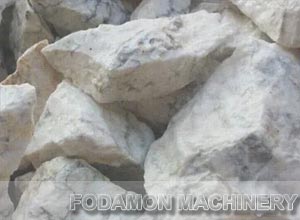
Magnesite Ore Processing and Grinding Solution
Magnesite is a carbonate mineral composed mainly of magnesium carbonate (MgCO₃). It is one of the most important industrial minerals used in refractory production, magnesium compound manufacturing, metallurgy, chemical processing, environmental applications, and construction materials. High-grade magnesite is especially valuable for producing dead burned magnesia (DBM), caustic calcined magnesia (CCM), fused magnesia, and refractory bricks for steel and cement industries.
Depending on the deposit type and industrial requirement, magnesite ore may require crushing, screening, grinding, classification, calcination, and beneficiation. Proper particle size control is extremely important because different downstream industries require different fineness levels and purity standards. Fodamon can provide customized crushing and grinding solutions for magnesite processing according to ore hardness, moisture content, required fineness, capacity, and final industrial application.
In many countries, magnesite is also closely connected with steelmaking, non-ferrous metallurgy, cement plants, refractory manufacturing, agriculture, and environmental protection industries. Stable crushing and grinding systems help improve product consistency and downstream production efficiency.
Magnesite Mineral Characteristics
- High Magnesium Carbonate Content – Magnesite is mainly composed of magnesium carbonate and is an important raw material for magnesium-related industrial products.
- Excellent Refractory Performance – Calcined magnesite products have high heat resistance and are widely used in steelmaking furnaces and refractory industries.
- Wide Industrial Applications – Magnesite can be used in metallurgy, chemical production, environmental treatment, agriculture, and construction materials.
- Suitable for Grinding Processing – Many industrial applications require magnesite powder with controlled fineness, making grinding and classification important.
Magnesite Processing Overview
The magnesite processing flow generally includes crushing, grinding, classification, and sometimes calcination or beneficiation. Large magnesite rocks are first reduced by jaw crusher, followed by secondary crushing if required. After crushing, the material enters grinding equipment such as Raymond mill or ball mill to achieve suitable powder fineness.
In high-purity magnesite projects, beneficiation may also be required to remove silica, iron impurities, or associated gangue minerals. For refractory-grade magnesite, stable particle size and chemical composition are extremely important for downstream calcination and furnace applications.
Typical Magnesite Processing Flow
Raw Magnesite Ore → Vibrating Feeder → Jaw Crusher → Secondary Crusher → Grinding Mill → Classifier → Calcination / Powder Collection → Final Product
Recommended Equipment for Magnesite Processing
1. Jaw Crusher for Primary Crushing
The jaw crusher is commonly used for primary crushing of magnesite ore. It can efficiently reduce large magnesite rocks into smaller sizes suitable for secondary crushing or grinding preparation.
2. Cone Crusher or Impact Crusher for Secondary Crushing
Depending on ore hardness and production requirements, either cone crusher or impact crusher may be selected for secondary crushing. Cone crusher is suitable for harder material and stable large-scale production, while impact crusher provides flexible crushing and better particle shaping for some applications.
3. Raymond Mill for Magnesite Powder Production
The Raymond mill is widely used for magnesite grinding. It can produce fine powder with stable fineness and low energy consumption, making it suitable for refractory powder, chemical material, and industrial filler production.
4. Ball Mill for Fine Grinding
For projects requiring finer particle liberation or higher grinding capacity, the ball mill can be used. Ball mills are suitable for continuous industrial grinding and can work together with classifiers for precise powder control.
5. Classifier and Dust Collection System
Classification systems help control the final powder fineness, while dust collection equipment improves environmental performance and powder recovery efficiency during grinding operations.
Applications of Magnesite
Magnesite is one of the most important non-metallic minerals in modern industry. Different particle sizes and calcination conditions allow magnesite to be used in many industrial sectors.
- Refractory bricks and furnace lining materials
- Steelmaking and metallurgical industries
- Magnesium oxide and magnesium chemical production
- Environmental desulfurization and wastewater treatment
- Construction materials and industrial fillers
- Agricultural magnesium supplements and soil improvement
Magnesite Grinding and Powder Requirements
Different industries require different magnesite powder fineness. Refractory production may require controlled coarse and medium powder sizes, while chemical and environmental industries may need finer powder with higher purity.
Proper grinding system design helps improve powder uniformity, reduce energy consumption, and stabilize downstream calcination or chemical reactions. Raymond mill systems are often selected for medium-fine powder production, while ball mill systems may be preferred for larger capacity or finer grinding requirements.
Magnesite Calcination and Industrial Use
After crushing and grinding, magnesite is often calcined at high temperature to produce magnesium oxide products. Different calcination temperatures create different industrial materials:
- Caustic Calcined Magnesia (CCM) – Used in chemical industry, agriculture, environmental treatment, and construction materials.
- Dead Burned Magnesia (DBM) – Mainly used for refractory bricks, steel furnaces, and high-temperature industrial applications.
- Fused Magnesia – High-purity refractory material for advanced metallurgical applications.
How to Choose a Magnesite Processing Plant
A suitable magnesite processing line depends on ore purity, feeding size, required powder fineness, calcination requirements, and final industrial application. For coarse crushing and aggregate preparation, jaw crusher and cone crusher may be sufficient. For industrial powder production, grinding mills and classification systems become the key equipment.
Fodamon engineers can help customers select suitable crushing and grinding equipment according to raw ore conditions, production capacity, power requirements, and downstream industrial standards.
Information Needed Before Equipment Selection
- Raw magnesite ore size
- Ore purity and associated impurities
- Required final powder fineness
- Expected production capacity
- Calcination requirement
- Plant layout and power condition
- Final industrial application
FAQ About Magnesite Processing
What is magnesite mainly used for?
Magnesite is mainly used for refractory materials, magnesium oxide production, metallurgy, environmental protection, agriculture, and construction industries.
Which mill is suitable for magnesite grinding?
Raymond mill is commonly used for medium-fine magnesite powder production, while ball mill may be selected for larger capacity or finer grinding requirements.
Does magnesite require calcination?
Many industrial applications require calcined magnesite products such as CCM or DBM. Calcination temperature depends on the final industrial purpose.
Can magnesite be processed into refractory material?
Yes. High-purity magnesite is one of the most important raw materials for refractory bricks and furnace lining products used in steelmaking and high-temperature industries.
What factors affect magnesite grinding efficiency?
Ore hardness, moisture content, feeding size, grinding fineness requirement, and mill selection all influence grinding efficiency and final powder quality.
Need a Magnesite Processing Solution?
Tell us your raw ore size, required powder fineness, production capacity, calcination requirement, and final industrial application. Fodamon can help you design a customized magnesite crushing, grinding, and powder processing solution.
Contact Fodamon today to get a professional magnesite processing solution.